Trump’s New Air Force One Paint Scheme: The 2026 Fleet-Wide Rollout
On February 17, 2026, aviation spotters outside the L3Harris facility in Greenville, Texas, captured a historic sight. A Boeing C-32A (Tail No. 99-0003) roared down the runway, not in the familiar “Robin’s Egg Blue” aimed at the sky, but in a deep navy, white, and red livery. This test flight signaled the official end of the 64-year design era established by Raymond Loewy and President Kennedy.
For years, the Air Force One paint scheme sparked intense political and design debate. Was it too dark? Would it cause the jet to overheat? Was it simply a copy of Donald Trump’s private 757?
We now have the answers. The Air Force has finalized the technical requirements, resolved the thermal engineering hurdles, and begun applying the new look across the VIP fleet. This report breaks down the exact color specifications, the fleet-wide implementation involving a donated Qatari 747, and the engineering reality behind the red, white, and blue.
The 2026 Livery Specification: Beyond Red, White, and Blue
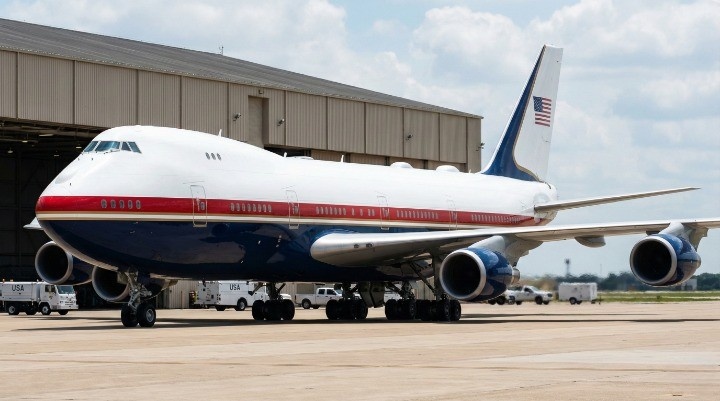
The new design is a major departure from the soft, diplomatic tones of the past. According to Official U.S. Air Force Statements (2026), the approved livery utilizes a four-color palette designed to project “American power and prestige.”
While most reports focus on the red, white, and blue, the fourth color is technically the most difficult to execute.
The “Fourth Color” – Why Gold Matters
Close inspection of the 2026 sightings reveals a distinct gold cheatline. This pinstripe separates the dark navy belly from the white upper fuselage.
-
Function: It acts as a visual transition, preventing the dark navy from clashing with the bright white.
-
Placement: The gold line runs the entire length of the fuselage, sweeping up the tail.
-
Engineering Challenge: Metallic paints often interfere with radar and communication antennas. Boeing and L3Harris had to develop non-conductive metallic coatings to ensure the VC-25B’s “flying Pentagon” capabilities remained 100% operational.
Comparing “Trump Force One” vs. VC-25B
Critics initially claimed the new Air Force One paint scheme was a direct clone of the President’s private jet. While the inspiration is undeniable, the execution differs significantly to meet military standards.
The First Sighting: C-32A “Vader 20” and the L3Harris Testing
The Air Force One paint scheme is not limited to the Jumbo Jet. It is a fleet-wide rebranding. The first aircraft to wear the colors was a C-32A (the military version of the Boeing 757), often used as Air Force Two.
Why Air Force Two Got the Paint First
The C-32A fleet operates on a tighter maintenance schedule than the larger VC-25s. Aerospace Global News (2026) reported that Tail No. 99-0003 was due for a “D-Check” (heavy maintenance), making it the perfect candidate for the first repaint.
This approach allows the Air Force to:
-
Test Durability: See how the dark navy paint holds up to UV radiation and runway debris.
-
Verify Temperature: Confirm cabin cooling systems can handle the increased heat absorption from the dark belly.
-
Standardize the Brand: Ensure the Vice President and Cabinet secretaries project the same visual authority as the President.
Pro-Tip for Spotters: If you are tracking these jets on ADS-B Exchange, look for callsigns like “VENUS” or “SAM” (Special Air Mission). The new livery is distinct even from a distance because the dark belly makes the fuselage appear slimmer than the older white-bellied versions.
The “Stopgap” Solution: The Qatari 747-8i Transformation
Perhaps the most fascinating element of the 2026 fleet update is the aircraft that wasn’t supposed to be there.
From Royal Gift to Presidential Transport
The Air Force is currently retrofitting a Boeing 747-8i originally gifted to the U.S. by the state of Qatar. This aircraft arrived with very low flight hours and a VVIP interior. [External Link: The War Zone – Qatari 747 Analysis]
Timeline for the 2026 “Interim” Air Force One
Unlike the purpose-built VC-25B (which is still under heavy modification), the Qatari jet is a standard commercial freighter frame converted for passenger use. L3Harris is installing encrypted communications and defensive countermeasures.
-
Current Status: Undergoing systems integration in Texas.
-
Paint Status: Scheduled for the new Air Force One paint scheme in late Q3 2026.
-
Role: It will serve as a “decapitation strike” survivor and backup transport, bridging the gap until the full VC-25B fleet arrives.
Overcoming the Thermal Hurdle: How Navy Blue Became Flight-Ready
In 2022, the Biden administration halted the “Trump Livery” project. The primary reason cited was thermodynamics. The VC-25B is packed with sensitive electronics, and engineers feared a dark blue underbelly would absorb too much solar heat, potentially frying the systems on the tarmac.
So, how did the 2026 rollout happen?
According to Air & Space Forces Magazine (2025), Boeing engineers implemented a two-part solution:
-
Solar Reflective Pigments: The navy blue paint now contains specialized reflective compounds that mimic lighter colors in the infrared spectrum. To the human eye, it looks dark; to the sun, it acts like gray.
-
Enhanced Environmental Control System (ECS): The onboard cooling capacity was increased to compensate for the remaining heat load.
This engineering fix allowed the Air Force to meet the Commander-in-Chief’s visual requirements without compromising the safety of the nuclear command and control suite on board.
The Future of the VC-25B: 2028 Delivery and Beyond
While the paint is applied, the jets themselves are behind schedule. The Air Force One paint scheme is the visible layer of a program plagued by delays.
The Fixed-Price Contract and Boeing’s $5B Reality
The program operates under a $3.9 billion fixed-price contract signed in 2018. This means Boeing—not the taxpayer—pays for cost overruns. As of early 2026, Reuters reports Boeing has swallowed over $2 billion in losses on the project due to supply chain issues and the complexity of the “hand-crafted” wiring needed for the jet’s defense systems.
The first fully operational VC-25B Air Force One is now projected for delivery in 2028. Until then, the current VC-25A (the classic blue 747-200s) and the repainted C-32As will carry the weight of the presidency.
Summary
The return of the dark navy Air Force One paint scheme in 2026 marks a definitive shift in American aerial diplomacy.
-
The Colors: Dark Navy, White, Red, and Gold are the new standard.
-
The Fleet: C-32As are already flying the colors; the VC-25Bs will follow.
-
The Tech: Thermal coatings solved the heat issues that threatened to cancel the project.
While the design is often debated as a matter of taste, the engineering behind it remains world-class. The VC-25B will be a flying fortress, capable of withstanding electromagnetic pulses and serving as a secure bunker in the sky—regardless of the color on the tail.
Have you spotted the new livery at Joint Base Andrews or elsewhere? Share your sightings and photos in the comments below.
FAQs
-
Is Air Force One being repainted?
-
Yes. As of 2026, the Air Force has begun repainting the VIP fleet, starting with the C-32A (Air Force Two). The main VC-25B aircraft will be delivered with this new scheme.
-
What color is the new Air Force One?
-
The official palette includes a dark navy blue underbelly, a white upper fuselage, a red stripe, and a gold cheatline separating the blue and white.
-
Why was the blue and white Air Force One design changed?
-
The change was initiated to provide a more “patriotic” look that aligns with the colors of the American flag. The previous “Robin’s Egg Blue” design had been in use since 1962.
-
Did Trump design the new Air Force One paint?
-
Donald Trump proposed the initial design in 2019, heavily influenced by his private jet. The Air Force adapted this concept into a military-grade specification that met safety and thermal requirements.
-
What happened to the Qatari 747 gift?
-
The donated Qatari 747-8i is currently being retrofitted by L3Harris to serve as a specialized presidential support aircraft and will eventually wear the new livery.
-
When will the new VC-25B be delivered?
-
Due to production delays, the first VC-25B is scheduled for delivery in 2028, roughly four years later than the original 2024 target.
-
Is the new Air Force One paint causing overheating?
-
Not anymore. While thermal issues were a concern in 2022, engineers solved the problem using solar-reflective paint coatings and upgraded cooling systems.