Jeroen Dik vs. Joris Dik: Clearing the 2026 Art & Engine Confusion
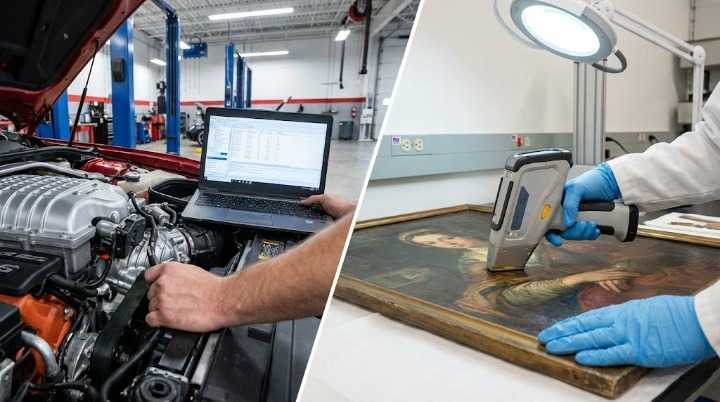
Imagine searching for a specialist to remap your high-performance Audi engine and stumbling upon a research paper about hidden pigments in a Vincent van Gogh painting. In 2026, the digital identity of Jeroen Dik has become a fascinating case of mistaken identity.
One name dominates the Volkswagen performance scene in Europe. A nearly identical name leads the world in X-ray art conservation. To make matters worse, recent media reports frequently conflate the two, leaving enthusiasts and academics scratching their heads.
This article provides the definitive breakdown of Jeroen Dik (the automotive pioneer behind JD Engineering) and Joris Dik (the materials scientist at TU Delft). Whether you are looking for horsepower or art history, you need the right expert.
The Dik Identification Matrix (2026 Edition)
Before we dive deep, let’s look at the facts. This table resolves the immediate confusion.
Jeroen Dik: The Architect of VAG Performance Engineering
If you drive a Volkswagen, Audi, SEAT, or Skoda, Jeroen Dik is a household name. He isn’t just a mechanic; he is an architect of modern European car tuning.
The Founding of JD Engineering (1997–Present)
Jeroen Dik established JD Engineering in the late 1990s in Lochem, Netherlands. At the time, “tuning” often meant crude mechanical adjustments or soldering physical chips onto circuit boards. Jeroen took a different approach. He treated the engine as a data system.
According to JD Engineering’s official corporate history, the firm started by specializing in G-Lader compressors found in the VW G60 engines. These superchargers were notoriously fragile if mishandled. Jeroen developed modification protocols that increased boost pressure without destroying the unit, earning him early trust in the community.
From G60 to Modern ECU Remapping
The industry shifted rapidly from mechanical tuning to software calibration in the early 2000s. Jeroen Dik pivoted with it. He became one of the first engineers to master the complexities of the Bosch Motronic ECU (Engine Control Unit).
Expert Insight:
Many “tuners” simply buy generic files online and upload them to your car. Jeroen Dik writes his own software. He tests these files on an in-house Superflow 4WD rolling road (dynometer). This machine simulates real-world drag and load, allowing him to see exactly how the engine behaves at 150 MPH without leaving the shop.
Reliability vs. Raw Power
Jeroen’s philosophy differs from the typical “max power” mindset found in American drag racing. His focus is thermal management.
An engine can make 600 horsepower for ten seconds, but can it do it for two hours on the Autobahn? Jeroen Dik builds for the latter. His custom software monitors exhaust gas temperatures (EGT) and adjusts fuel mixture dynamically to prevent the engine from melting itself. This “reliability-first” approach is why VAG dealers in Europe often unofficially recommend his work.
[JD Engineering Official Portfolio]
Joris Dik: Peering Through the Layers of Art History
While Jeroen optimizes engines, Joris Dik optimizes our understanding of history. As the Professor of Materials in Art & Archaeology at Delft University of Technology (TU Delft), Joris has revolutionized how museums look at paintings.
The TU Delft Chair and Academic Roots
Joris Dik earned his PhD in Chemistry from the University of Amsterdam in 2003. His dissertation focused on “Naples Yellow,” a historical pigment used by Old Masters. This unique blend of hard chemistry and art history set the stage for his tenure at TU Delft.
He doesn’t just look at art; he analyzes its atomic structure. His work bridges the gap between the humanities and the hard sciences, often collaborating with institutions like the Rijksmuseum and the Getty Conservation Institute in Los Angeles.
Breakthrough: The X-ray Fluorescence (XRF) Revolution
In 2008, the art world stopped. A team led by Joris Dik used synchrotron radiation-based X-ray fluorescence to scan Vincent van Gogh’s 1887 painting, Patch of Grass.
Art historians had long suspected Van Gogh painted over an older image to save money on canvas. Using high-energy X-rays at the Deutsches Elektronen-Synchrotron (DESY) in Hamburg, Joris’s team mapped the distribution of chemical elements like mercury and antimony (found in specific paint colors).
The result was a reconstructed color image of a peasant woman’s face hidden beneath the grass. This was non-destructive testing (NDT) at its finest—no paint chips were removed, no varnish was touched.
Beyond Van Gogh: Vermeer and the “Girl with a Pearl Earring”
Joris Dik’s work didn’t stop in 2008. Between 2020 and 2025, his team applied advanced Macro-XRF (MA-XRF) scanning to Johannes Vermeer’s Girl with a Pearl Earring.
Technical Deep Dive: How MA-XRF Works
-
The Beam: An X-ray beam scans the painting pixel by pixel.
-
The Reaction: The atoms in the paint absorb the X-rays and emit their own fluorescent energy.
-
The ID: Each element (Lead, Iron, Copper) emits a unique energy signature.
-
The Map: Software compiles these signatures into a “map” showing exactly where the artist used lead white or iron oxide, revealing changes the artist made during the painting process.
[TU Delft Research Portal – Materials in Art]
Why the Confusion? The 2026 Jeroen Dik Identity Split
If these two men are so different, why does Google mix them up?
Debunking the “Art Conservator Jeroen” Myth
The confusion stems from a simple linguistic slip. “Jeroen” and “Joris” are both common Dutch names. In 2024 and 2025, several major tech blogs and aggregators published articles about the “Van Gogh discovery” but erroneously cited the lead researcher as “Jeroen Dik.”
Because Jeroen Dik (the tuner) has a strong digital footprint with JD Engineering, search engines began associating his name with art conservation keywords. This created a feedback loop where searching for “Jeroen Dik Art” returned results for a car mechanic.
The Third Figure: Jeroen Dik the Hospitality Executive
To complicate matters further, there is a third prominent figure: Jeroen Dik, a Managing Director within the Accor hotel group (Mövenpick/Swissôtel) in the Benelux region. While successful in hospitality, he is unrelated to both the synchrotron experiments and the dyno tuning.
The Shared Excellence: Engineering vs. Preservation
Despite their different fields, Jeroen Dik (Auto) and Joris Dik (Science) share a methodology that defines Dutch engineering: Data over assumption.
Synchrotrons and Dynos: It’s All About Data
Jeroen Dik uses a dyno to visualize the invisible torque curve of an engine. Joris Dik uses a synchrotron to visualize the invisible layers of a painting. Both rely on interpreting complex data sets to reveal the truth.
-
In the Garage: If the data shows a lean fuel mixture, the engine blows up.
-
In the Lab: If the data misinterprets the lead signature, a fake painting might be authenticated as real.
2026 Industry Impact: Sustainable Steel and EVs
As we move through 2026, both men are evolving.
-
Joris Dik is currently leading research into “Sustainable Steel,” using scrap metal analysis to create cleaner recycling processes—a critical step for the global steel industry.
-
Jeroen Dik has expanded JD Engineering’s scope to include Electric Vehicle (EV) optimization, tweaking throttle mapping and battery thermal management for the VW ID series and Audi e-tron.
Summary
The distinction is clear.
-
If you need more torque from your Golf GTI or want to understand the limits of your VAG gearbox, you are looking for Jeroen Dik of JD Engineering.
-
If you are researching X-ray diffraction, Van Gogh’s hidden layers, or the chemistry of Old Master pigments, you are looking for Professor Joris Dik of TU Delft.
Both are pioneers. Both are leaders. But only one can fix your boost leak.
Which Dik were you looking for today? Share this guide to help stop the 2026 identity confusion.
FAQ
Are Jeroen Dik and Joris Dik the same person?
No. Jeroen Dik is an automotive engineer known for JD Engineering. Joris Dik is a professor of Materials Science specializing in art conservation at TU Delft.
What is Jeroen Dik’s JD Engineering known for?
They specialize in high-performance software tuning (chiptuning) for Volkswagen, Audi, SEAT, Porsche, and Skoda vehicles.
Who found the hidden painting behind Van Gogh’s ‘Patch of Grass’?
That was Joris Dik, along with a team of scientists, using synchrotron X-ray fluorescence in 2008.
Is Jeroen Dik a racing driver?
Yes. Jeroen Dik has a successful history in Dutch touring car racing, specifically with the DNRT (Dutch National Racing Team), which informs his tuning work.
Does Jeroen Dik do art restoration?
No. This is a common internet myth caused by search engines confusing him with Joris Dik.
What is Macro-XRF (MA-XRF) in art?
It is a non-destructive imaging technique pioneered by researchers like Joris Dik. It maps the chemical elements in paint layers without touching the canvas.
Where is JD Engineering located?
The headquarters is located in Lochem, a town in the eastern Netherlands.
What is Joris Dik’s current research focus?
As of 2026, his work has expanded to include “Circular Product Design” and sustainable steel recycling, alongside his continued work in heritage science.