Solar Panel Cleaning: Is Dirty Glass Killing Your ROI in 2026?
You invested thousands in a photovoltaic system to save money, not to watch your potential energy vanish into thin air. Yet, across the United States, solar arrays are silently losing revenue every single day. The culprit isn’t cloud cover or aging hardware. It is simple, accumulated grime.
Recent data from the National Renewable Energy Laboratory (NREL) suggests that in arid regions like California, Arizona, and Nevada, soiling—the technical term for dirt, pollen, and bird droppings on panels—can reduce annual energy production by up to 30% if left unchecked.
Think of it as an “invisible thief.” You might not notice a daily drop of 0.5%, but over a month, that layer of dust compounds. By the time you see a visible film on the glass, you have likely already lost significant kilowatt-hours (kWh).
This guide isn’t just about solar panel cleaning; it is about protecting your financial return on investment (ROI). We will break down the 2026 standards for maintenance, the dangers of “hard water,” and why a garden hose might be the worst tool for the job.
The Hidden Cost of “Self-Cleaning” Myths
A persistent myth in the solar industry is that panels are “self-cleaning.” Sales teams often tell homeowners that rain will wash away the dirt. While technically true for loose dust, this advice is dangerous for your long-term efficiency.
Why Rain Isn’t Enough (The “Mud-Puddle” Effect)
Rain does not clean solar panels; it rinses them. Think about your car windshield. If you leave your car parked outside for a month and it rains, does the glass come out sparkling clean? No. The water mixes with the dust to create a muddy film that dries into a hard crust.
On a solar module, this crust blocks sunlight from reaching the photovoltaic cells. It creates shading on the microscopic level. Worse, if you live near a highway or in an agricultural zone (like California’s Central Valley), that “dirt” often contains oily vehicle exhaust or sticky fertilizers that rain cannot dissolve.
Soiling Losses by Region: CA, AZ, and NV Stats
Geography dictates your maintenance schedule. A homeowner in rainy Seattle faces a completely different set of challenges than a solar farm operator in the Mojave Desert.
According to 2026 projections from the International Energy Agency (IEA-PVPS), soiling losses vary strictly by climate:
If you are in a high-loss zone, ignoring solar panel maintenance isn’t just lazy—it’s expensive.
DIY Solar Cleaning: A Step-by-Step 2026 Safety Protocol
For residential homeowners, hiring a pro isn’t always necessary if you have a single-story home and the right equipment. However, the days of climbing a ladder with a bucket of dish soap are over. Modern solar tech requires specific handling to avoid damage.
The Ground-First Approach: Equipment You Need
Safety is your priority. Falls from ladders are a leading cause of home-maintenance injuries. The 2026 standard for DIY cleaning is “Stay on the Ground.”
-
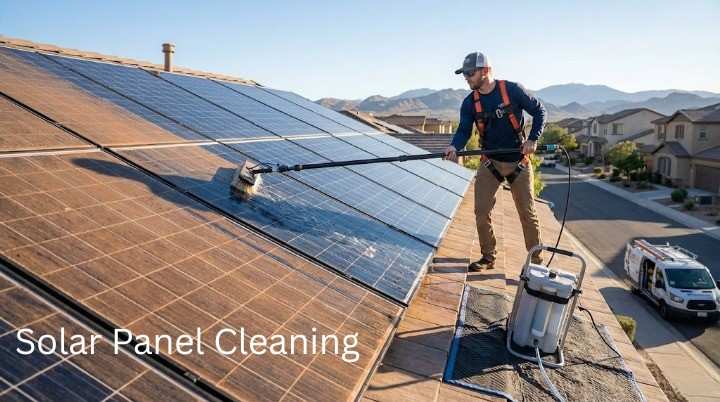
Telescopic Water-Fed Pole: These extend 20–30 feet and allow you to scrub roof panels from your driveway.
-
Soft Bristle Brush: Nylon bristles meant for solar glass (not stiff deck brushes that scratch).
-
Deionized Water System: A simple filter tank that removes minerals from your hose water.
The “Tap Water” Warning: Why TDS Levels Matter
This is where most DIYers fail. You cannot use straight tap water to clean hot solar panels.
My Pro-Tip: The Tap Water Test Grab a clear glass from your kitchen. Fill it with tap water and let it sit on your counter until it evaporates. See that white, chalky ring left behind? That is calcium and magnesium—also known as limescale or “hard water.” If you spray tap water on your hot solar panels, the water evaporates instantly, baking those minerals onto the glass. These spots create permanent shading that is harder to remove than the original dirt. The Fix: Use a hose filter or specialized “spot-free” rinse system to lower the Total Dissolved Solids (TDS) in your water.
Phase-by-Phase Cleaning Instructions
-
Shut Down: Turn off your PV system at the inverter or DC disconnect box. Safety first.
-
Cool Down: Never clean panels when they are hot (mid-day). The thermal shock can shatter the glass. Early morning (6 AM – 8 AM) is best.
-
Rinse: Use low pressure to wet the panels and loosen large debris.
-
Scrub: Gently agitate the dirt with your soft brush. Let the weight of the pole do the work; do not grind it in.
-
Final Rinse: Rinse thoroughly with deionized/filtered water to ensure no spots remain.
Professional Cleaning vs. Autonomous Robotics: Which Wins?
For commercial sites or homeowners with steep second-story roofs, professional help is the smarter route. But the industry is shifting. In 2026, we are seeing a massive rise in autonomous robotic cleaning.
The Rise of Waterless Robotic Cleaning in 2026
Water scarcity in the US West has driven innovation. New “dry cleaning” robots use soft microfiber wipers and airflow to whisk dust off panels every single night.
-
Advantage: Your panels start every morning at 100% efficiency.
-
Sustainability: Zero water usage—a massive plus for California regulations.
-
Cost: While the upfront hardware is pricey, the long-term savings on water trucks and manual labor are huge for commercial solar farms.
Cost Analysis: When does a pro service pay for itself?
If you opt for manual professional solar cleaning, expect to pay between $15 and $25 per panel in the US market. A typical 20-panel residential system costs roughly $300 – $500 per visit.
The Math: If your $300 cleaning restores 15% efficiency to a system that generates $2,500 of electricity a year, you recover roughly $375 in energy value. The service pays for itself, and your equipment lasts longer.
The Warranty Trap: 5 Mistakes That Void Your Coverage
Solar panels are durable, but they aren’t indestructible. Manufacturers like SunPower, LG, and QCELLS have strict warranty terms. Violating them can leave you with a $20,000 paperweight.
Thermal Shock: The Danger of Cold Water on Hot Glass
Solar panels can reach temperatures of 140°F (60°C) or higher on a summer day. Hitting that hot glass with 60°F water from a garden hose causes rapid contraction. This creates “micro-cracks”—invisible fractures in the silicon cells. You won’t see them with the naked eye, but they sever the electrical pathways inside the panel, permanently lowering output.
Chemical Corrosion: Why Dish Soap is the Enemy
The $5,000 Mistake A client in Phoenix once decided to pressure-wash his array using a high-strength driveway cleaner. He thought he was being thorough. The Result: The high pressure stripped the anti-reflective coating (ARC) off the glass, and the harsh chemicals corroded the aluminum frames. The manufacturer denied his warranty claim immediately. Lesson: Never use high-pressure washers (over 1,500 PSI) or abrasive chemicals. Stick to plain deionized water or dedicated solar soaps with a neutral pH.
Regional Maintenance Matrix: When to Clean Your Panels
Your location defines your schedule.
Post-Wildfire Ash Protocol (West Coast Specifics)
If you live in a wildfire zone, ash is a major enemy. Ash particles are larger and more abrasive than standard dust.
-
Action: Do not wipe dry ash! It acts like sandpaper.
-
Protocol: You must flood the panels with water first to float the ash off the surface before any brush touches the glass.
Seasonal Pollen & Agricultural Dust (Midwest/Central Valley)
Spring pollen is sticky. A simple rinse won’t move it.
-
Action: This season requires mechanical agitation (brushing).
-
Timing: Schedule your clean immediately after the peak pollen drop in late spring to ensure maximum generation during the high-sun summer months.
Frequently Asked Questions
Do solar panels need cleaning if it rains frequently?
Yes. Rain does not remove bird droppings, pollen, or sticky pollution. In fact, light rain often turns dust into mud. You still need a manual clean or a heavy rinse periodically.
How much does professional solar panel cleaning cost in 2026?
The national average is between $15 and $25 per panel. Flat rates for standard residential homes usually range from $300 to $500.
Can I use a pressure washer on solar panels?
No. High pressure can force water past the seals, damage the junction box, and strip anti-reflective coatings. Most manufacturers explicitly void warranties if pressure washers are used.
What is the best time of day to clean solar modules?
Early morning or late evening. Never clean during midday when panels are hot; water evaporates too fast (leaving spots) and risks thermal shock damage.
Does solar panel cleaning void my manufacturer warranty?
Only if done incorrectly. Using harsh chemicals, abrasive pads, or high pressure will void it. Following the manufacturer’s maintenance manual (usually just water and a soft brush) keeps your warranty intact.
What is waterless or dry robotic cleaning?
These are autonomous robots that use microfiber clothes and air jets to clean panels without water. They are increasingly popular in drought-prone areas like Arizona and California.
Can I use regular glass cleaner or Windex?
Avoid it. Standard glass cleaners often leave a residue or film that attracts more dust. Plain deionized water is the industry standard.
How do I know if my panels are losing efficiency?
Check your monitoring app (like Enphase or SolarEdge). Compare your current production to the same month last year. A drop of more than 5-10% (accounting for weather) usually indicates soiling.
Conclusion
Ignorance is the only thing more expensive than maintenance. Letting your solar panels sit under a layer of grime is equivalent to throwing money away. Whether you choose to invest in a telescopic pole for a Saturday DIY project or hire a professional service, the goal remains the same: protect your asset.
Clean Early, Clean Often. In 2026, the data is clear. Keeping your glass transparent is the single most effective way to guarantee your system pays for itself. Don’t let the invisible thief steal your power.
[Check out our guide on the Top 5 Solar Monitoring Apps for 2026] [Department of Energy – Solar Maintenance Best Practices]
About the Author