
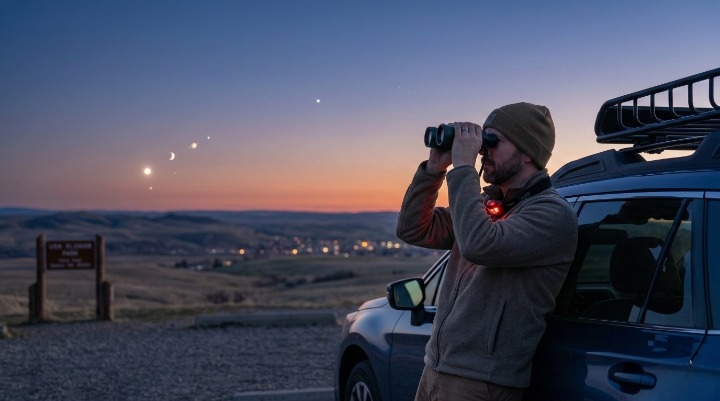
Planetary Alignment 2026: Your Expert Guide to the February “Planet Parade”
On the evening of February 28, 2026, a rare celestial geometry will bring six worlds into a single field of view. This event is the undisputed highlight of the NASA 2026 space calendar. But for most Americans, simply walking out to the driveway and looking up will not guarantee a good show.
Catching the planetary alignment 2026 requires precise timing and a solid understanding of your local horizon. Atmospheric haze and light pollution easily hide the fainter planets from untrained eyes. This guide breaks down the exact timing, optical requirements, and field-tested strategies you need to actually spot all six planets before they sink out of sight.
What is the 2026 Planetary Alignment? (The Science of the Parade)
Understanding Celestial Mechanics vs. Visual Grouping
A planetary alignment does not mean the planets form a perfectly straight line in outer space. That is a common myth. Instead, this is a visual grouping created by our specific vantage point on Earth.
All major planets orbit the sun on roughly the same flat plane. When we look up, this plane translates to an imaginary arc across our sky called the ecliptic path. During a “planet parade,” multiple planets happen to cluster in the same section of this arc at the same time.
The 6-Planet Lineup: Who is Invited?
To set realistic expectations, you must understand astronomical magnitude. Lower numbers mean brighter objects. Here is what you are actually hunting for during the 2026 planetary alignment:
| Planet | Visual Magnitude | Visibility Level | Required Gear |
| Venus | -3.8 | Blindingly Bright | Naked Eye |
| Jupiter | -2.3 | Exceptionally Bright | Naked Eye |
| Mercury | 0.3 | Moderately Bright | Naked Eye (Clear Horizon Needed) |
| Saturn | 1.0 | Visible | Naked Eye |
| Uranus | 5.8 | Very Faint | Binoculars / Small Telescope |
| Neptune | 7.8 | Invisible to Naked Eye | 4-inch Telescope Minimum |
When and Where to See the Planetary Alignment 2026
The Peak Window: February 28, 2026
The absolute best time to view the six planets together is the evening of February 28. Official data from NASA Science Skywatching confirms the optimal viewing window opens during astronomical twilight.
You need to be outside and ready exactly 30 to 60 minutes after your local sunset. For most locations in the USA, this falls roughly between 6:00 PM and 7:00 PM. Arrive late, and the lowest planets will already be gone.
Finding the Sweet Spot: West-Southwest Horizon
You must face West-Southwest. Jupiter will act as your bright, brilliant anchor high up in the Southeast near the Gemini constellation. Uranus trails near the Pleiades star cluster. The real challenge lies low on the horizon where Mercury, Venus, Saturn, and Neptune cluster together.
Field Note: Always respect the “10-degree rule.” Objects lower than 10 degrees above the horizon look dimmer because you are looking through a thicker slice of Earth’s atmosphere. You absolutely need a viewing spot free of tall trees, buildings, or hills to the West. A flat field at a local state park or a west-facing beach is ideal.
Step-by-Step: How to See the Planets Based on Your Gear
The Naked-Eye Targets (Jupiter, Venus, Saturn, Mercury)
You do not need expensive equipment to enjoy the main event. Four of the six planets are visible to the naked eye if the sky is clear.
- Locate Venus first. It will be the brightest object in the West right after sunset.
- Find Jupiter next. Turn slightly Southeast and look high up for the second brightest beacon.
- Spot Saturn and Mercury. Look just below and slightly away from Venus.
- Apply the Twinkle Test. If you are unsure if you are looking at a planet or a star like Sirius, watch its light. Stars twinkle violently. Planets shine with a steady, solid glow.
Using Optics for the Ice Giants (Uranus and Neptune)
Seeing the gas giants is easy. Spotting the ice giants requires proper optics and dark skies.
Uranus sits near the edge of human vision. You can easily catch it with standard 10×50 binoculars. Neptune is the boss-level target of this planetary alignment. At magnitude 7.8, it demands a telescope with at least a 4-inch aperture.
You also need to understand your local light pollution. Check a dark sky map and find a location that registers at Class 4 or lower on the Bortle scale. City lights will entirely wash out Neptune. [IGuide to Choosing Your First Telescope]
Expert Pro-Tips for the 2026 Planetary Alignment (The Experience Factor)
The Binocular Bracing Technique for Stability
Holding binoculars perfectly still is incredibly difficult, especially when you are freezing in a dark field. Shaky hands make faint targets like Uranus disappear.
Do not rely on your arms alone. Rest your elbows on the roof of your car, lean heavily against a solid fence, or sit in a reclining lawn chair. Bracing your body turns your standard binoculars into a stable optical platform, drastically widening your effective field of view.
Managing Atmospheric Extinction and Haze
Amateur stargazers often check their weather app, see a “clear skies” icon, and assume perfect viewing conditions. According to guidance from the Royal Observatory Greenwich, a clear sky does not mean a steady sky at the horizon.
Atmospheric extinction causes objects to lose brightness as they set. Even a thin layer of evening haze over the highway can swallow Mercury completely. Bring a star chart app like Stellarium to confirm exactly where the planets should be, even if haze temporarily hides them.
Do Not Stop There: The March 3rd Total Lunar Eclipse Connection
The planetary alignment 2026 kicks off a massive week for amateur astronomers. Just three days after the planet parade peaks, North America will experience a Total Lunar Eclipse on March 3, 2026. Keep your gear packed and your viewing spots scouted. This back-to-back celestial scheduling is incredibly rare and offers a perfect excuse to plan a dedicated stargazing camping trip.
FAQs
How many planets will align in 2026?
Six planets will visibly align: Mercury, Venus, Saturn, Jupiter, Uranus, and Neptune.
What time is the planetary alignment on Feb 28, 2026?
The best viewing window is 30 to 60 minutes after your local sunset.
Is the 2026 planetary alignment visible from the USA?
Yes. Observers across the USA will have an excellent view of the West-Southwest horizon, weather permitting.
Can I see the 6-planet alignment with the naked eye?
You can see four planets (Venus, Jupiter, Saturn, Mercury) with the naked eye. Uranus and Neptune require binoculars or a telescope.
What is the rarest planetary alignment?
An alignment of all eight major planets in the same tight quadrant of the sky is exceedingly rare, only occurring once every few centuries.
What constellation is Jupiter in during the 2026 parade?
Jupiter will be positioned high in the sky near the Gemini constellation.
Will the alignment cause any gravitational effects on Earth?
No. The combined gravitational pull of the planets is entirely negligible and will not cause earthquakes or extreme tides.
When is the next 5-planet alignment after 2026?
Another major alignment featuring Mars, Jupiter, Uranus, Saturn, and Neptune will occur in late December 2026.
Wrap Up and Next Steps
The planetary alignment 2026 offers a humbling look at our solar system’s orbital geometry. Standing in the dark and tracing the ecliptic path across the sky with your own eyes shifts your perspective from living on Earth to floating within a massive, structured solar system.
Do not wait until the evening of February 28 to figure out your plan. Check your local USA weather forecast today, scout a West-facing park with a flat horizon, and make sure your binoculars are clean and ready.
About the Author