
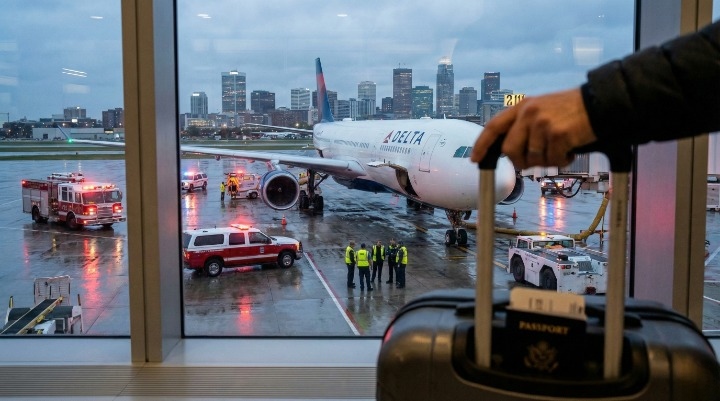
Delta Flight Emergency Landing: Deep Dive Into Recent Safety Incidents & 2026 Record
The red notification flashes across a flight tracking app: Squawk 7700.
For the average traveler, this code signifies panic. For aviation professionals, it signals a shift in protocol, a transition from standard operations to a prioritized safety matrix. In early February 2026, Delta Air Lines Flight DL234 triggered this exact sequence over the Irish Sea, diverting a fully fueled Airbus A330 to Dublin in the dead of night.
While headlines often sensationalize these moments, the reality of an emergency landing is a highly choreographed ballet of physics, engineering, and pilot training.
This article dissects the technical realities behind Delta’s recent 2026 incidents, specifically the Dublin medical diversion and the San Antonio engine smoke event. We will strip away the fear to examine the safety data, explaining what actually happens in the cockpit when the “Fasten Seatbelt” sign turns on for good.
Case Study 1: Delta Flight DL234 Medical Diversion (February 2026)
On the night of February 2–3, 2026, Delta Flight DL234 departed New York (JFK) bound for Tel Aviv. Approximately four hours into the transatlantic crossing, the crew declared a general emergency via Squawk 7700.
The Critical Decision at 36,000 Feet
The decision to divert is never taken lightly, especially on a long-haul route like JFK–TLV. According to reports from Simple Flying and Belfast Live, the diversion was triggered by a critical medical emergency onboard.
In these scenarios, the Captain becomes a risk manager. The flight was roughly equidistant between the US East Coast and Europe, but returning to New York would mean fighting headwinds. Continuing to Tel Aviv was impossible due to the patient’s condition. Dublin (DUB) became the optimal alternate airport, offering suitable medical facilities and a long runway capable of handling a widebody aircraft.
Understanding the “Heavyweight Landing” Procedure
The most complex aspect of the DL234 incident was the aircraft’s weight. The Airbus A330-900neo was fueled for a 10+ hour journey but was landing only four hours after takeoff. This meant the plane was significantly above its Maximum Landing Weight (MLW).
SME Insight: The Physics of a Heavyweight Landing
Pilots generally have two choices when an aircraft is too heavy to land:
- Fuel Dumping: Jettisoning fuel to reduce weight (time-consuming and not always possible in immediate emergencies).
- Overweight Landing: Landing immediately despite the weight.
In an overweight landing, passengers will feel a “firm” arrival. This is intentional. Pilots are trained not to “grease” the landing (a smooth touchdown) because a heavy aircraft needs to plant its wheels firmly to trigger the spoilers and auto-brakes immediately. A soft landing risks “floating” down the runway, eating up valuable stopping distance.
Result: The A330 landed safely. The high kinetic energy was absorbed by the carbon brakes, which likely required cooling fans or inspection by fire crews immediately upon stopping, a standard procedure, not necessarily an indication of fire.
Case Study 2: San Antonio Engine Smoke Incident (February 3, 2026)
Just hours after the Dublin incident, another Delta aircraft made headlines in the US. On Tuesday, February 3, 2026, a Delta flight departing San Antonio International Airport (SAT) for Atlanta was forced to return immediately after takeoff.
Precautionary Landing vs. Engine Fire
The flight, carrying 143 passengers, reported smoke indications from one of its engines. It is vital to distinguish between a “fire indication” and an “active fire.”
Modern aircraft sensors are incredibly sensitive. They can be triggered by oil leaks, sensor malfunctions, or actual combustion. In this instance, the pilots followed the QRH (Quick Reference Handbook) checklists, which prioritize isolating the affected engine and returning to the ground.
FAA Part 121 Protocols: Prioritizing the Return
Upon landing at 11:20 a.m. local time, the aircraft was met by the San Antonio Fire Department. According to Aviation Today, emergency responders found “no active fire” after a thermal inspection.
This outcome highlights the redundancy of FAA Part 121 operations (the regulations governing US commercial airlines). The “emergency” declaration allowed the pilots to obtain priority handling from ATC, clearing the airspace for an immediate return. The absence of fire proves the system works: the crew treated a potential threat as a confirmed one, ensuring a margin of safety that kept all 143 souls safe.
Decoding Aviation Safety: What “Squawk 7700” Really Means
You will see the term Squawk 7700 frequently in aviation news. It is not a “mayday” in the cinematic sense; it is a digital code entered into the aircraft’s transponder.
- 7500: Hijacking (Unlawful Interference)
- 7600: Radio Failure (Loss of Comms)
- 7700: General Emergency
When a pilot enters 7700, the aircraft’s icon turns red on Air Traffic Control screens. It silences other alarms in the control tower and gives that aircraft immediate authority to change altitude or heading without asking for permission first. It is a tool for priority, not necessarily a signal of impending doom.
Delta Air Lines 2026 Safety Record: A Data-Driven Analysis
To understand if these incidents are outliers, we must look at the broader data. As of early 2026, Delta Air Lines retains its position as a top-tier carrier in global safety rankings.
Comparative Performance
According to AirlineRatings.com’s 2026 Safest Airlines report, Delta ranks #23 globally. While this is a drop from previous top-20 positions (with Alaska Airlines taking the top US spot at #15), Delta remains in the elite tier of the world’s safest carriers.
It is crucial to context these numbers against the volume of flights. Delta operates over 4,000 flights daily. Two high-profile diversions in a week represent less than 0.01% of their operational schedule.
The Shadow of 2025: Delta Connection Flight 4819
Current traveler anxiety is partially fueled by the February 17, 2025 crash of Delta Connection Flight 4819 (operated by Endeavor Air) in Toronto.
- The Incident: A CRJ-900 experienced a hard landing, causing a landing gear fracture and wing detachment.
- The Outcome: All 80 occupants survived, though 21 were injured.
- The Lesson: The TSB (Transportation Safety Board of Canada) preliminary reports focused on the “hard landing” aspect. This event remains the most significant recent blemish on the extended Delta network’s record, serving as a stark reminder of why pilots train extensively for the “firm landings” discussed in the DL234 case.
The Future of Passenger Safety: New FAA Regulations for 2026
The FAA has responded to the industry-wide uptick in “close calls” seen in 2024 and 2025 with aggressive new infrastructure.
Runway Incursion Devices (RID): Following near-misses at airports like JFK and DCA, the FAA is currently rolling out enhanced surface surveillance technology to 74 major US airports. These systems alert controllers if a plane is lining up on a runway occupied by another aircraft, a direct countermeasure to the ground risks that lead to emergency braking events.
What To Do If Your Flight Declares an Emergency
If you are on a flight that begins an emergency descent:
- Listen, Don’t Film: Your attention must be on the Flight Attendants. They are safety professionals, not servers.
- Tighten Your Belt: Low and tight. Turbulence often accompanies rapid descents.
- Review the Card: Know where your nearest exit is, count the rows. In the Toronto incident, swift evacuation was key to survival.
Final Thoughts: Context Over Fear
Flying remains the safest activity a human being can participate in, far safer than the car ride to the airport. The emergency landings of Flight DL234 and the San Antonio return are not failures of the system; they are proof that the system works.
When a sensor detects smoke or a passenger falls ill, the airline stops the world to solve the problem. That is not a crisis; that is the definition of safety.
[Read full guide on Claiming Compensation for Flight Delays] [FAA Daily Accident & Incident Dashboard]
Disclaimer: The information in this article is based on verified aviation reports as of February 4, 2026. Safety regulations and incident details are subject to official NTSB/FAA final reports.
About the Author