
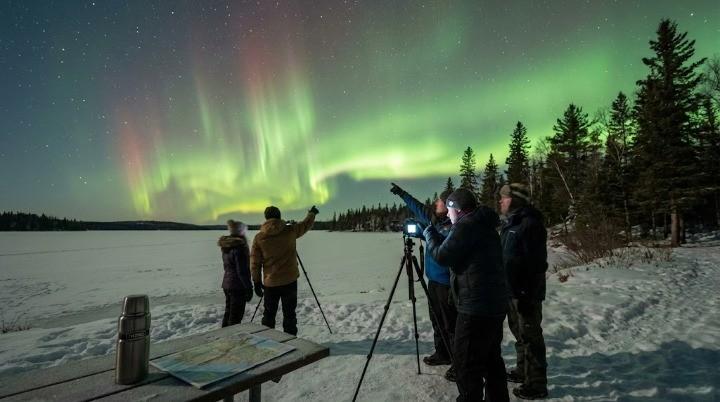
Aurora Borealis Forecast: How to See the Northern Lights in the USA (Feb 2026 Update)
The sun just woke up in a big way. On February 1, 2026, a massive sunspot region known as AR4366 unleashed an X8.3 solar flare. This isn’t just another space weather event. It is the strongest eruption recorded this year and a clear signal that the Solar Cycle 25 peak is in full swing.
For skywatchers in the United States, this means one thing. The northern lights aurora borealis forecast is looking better than it has in months.
You might have heard the alerts about a G2 geomagnetic storm watch for February 5 and 6. But seeing the lights isn’t just about luck. It requires knowing exactly where to look and how to interpret the data. We are currently in the “Golden Year” for auroras. The sun is at its solar maximum, firing charged particles toward Earth with intensity we haven’t seen in two decades.
This guide will help you cut through the noise. We will break down exactly which states have a front-row seat tonight, how to read the magnetic field data like a pro, and the camera settings you need to capture the show.
Tonight’s Visibility: Which States Can See the Lights?
When NOAA issues a storm watch, most people just look for their state on a list. That is a mistake. Visibility depends entirely on your latitude and the intensity of the storm, measured by the Kp-index.
For this week’s aurora borealis forecast, we are looking at a Kp-index hovering between 5 and 6. Here is the realistic breakdown of where you can see the action.
The “Overhead” Tier (Kp 5–6)
If you live in these states, you are in the prime viewing zone. The aurora oval should be directly above you or high in the northern sky. You have the best chance of seeing ribbons, curtains, and rapid movement.
-
Alaska (Statewide)
-
Washington (Northern counties)
-
Idaho (Panhandle region)
-
Montana (Statewide)
-
North Dakota (Statewide)
-
South Dakota (Northern half)
-
Minnesota (Statewide, especially Boundary Waters)
-
Wisconsin (Northern half, Door County)
-
Michigan (Upper Peninsula is prime, northern Lower Peninsula is good)
-
Maine (Statewide)
[ Check local cloud cover on Weather.gov]
The “Horizon” Tier (Kp 7+)
This is where expert knowledge comes in. Even if the northern lights aurora borealis forecast doesn’t explicitly list your state for overhead viewing, you aren’t out of luck. During strong G2 or G3 pulses, viewers in these states can often see a distinct green or red glow dancing low on the northern horizon.
-
Illinois (Northern counties, away from Chicago light pollution)
-
Iowa
-
Nebraska
-
Ohio (Lake Erie shoreline)
-
Pennsylvania (Cherry Springs State Park area)
-
New York (Upstate)
-
Massachusetts
My Experience Tip: If you are in the “Horizon Tier,” do not look straight up. Find a spot with a perfectly clear view to the North. A lake shore is ideal because water creates a flat horizon. The aurora will look like a strange, glowing dawn that shouldn’t be there.
The Science of the 2026 Solar Maximum
Why are we seeing so many alerts right now? We are currently living through the peak of Solar Cycle 25.
The sun operates on an 11-year cycle of activity. According to data from the NASA Solar Dynamics Observatory (2026), the sun’s magnetic field is currently flipping, creating a chaotic surface environment. Sunspots like AR4366 are magnetic knots that burst and send Coronal Mass Ejections (CMEs) hurtling toward Earth.
When these CMEs hit our planet’s magnetic shield, they compress it. This interaction excites gases in our atmosphere. Oxygen glows green and red. Nitrogen glows blue and purple. Because we are at the Solar Cycle 25 peak, these interactions are more frequent and more intense than they were five years ago. This is historically the best time in a decade to be an aurora hunter in the USA.
How to Read the Forecast Like a Pro
Most beginners rely on apps that give a simple percentage chance of seeing the lights. Professional chasers look at the raw data from the NOAA Space Weather Prediction Center.
To truly understand the northern lights aurora borealis forecast, you need to ignore the percentage and look at two specific numbers.
The Kp-Index vs. The Bz Component
The Kp-index is a scale from 0 to 9 that measures the global strength of a geomagnetic storm.
-
Kp 0-3: Calm. Only visible in the Arctic.
-
Kp 4-5: Active. Visible in northern US states.
-
Kp 6-9: Storm levels. Visible as far south as Kansas or Missouri.
However, a high Kp-index is useless if the “door” to Earth’s atmosphere is locked. That door is controlled by the Bz component of the Interplanetary Magnetic Field (IMF).
The Secret: You want the Bz to be Negative (South).
Think of Earth’s magnetic field as pointing North. If the solar wind’s magnetic field also points North (Positive Bz), they repel each other like two magnets. The door stays shut. No aurora.
But if the solar wind points South (Negative Bz), it connects with Earth’s field. The door opens. Energy pours in.
Pro-Tip: If your app shows Kp 6 but the Bz is +10nT, go back to bed. If it shows Kp 4 but the Bz is -15nT, get outside immediately. The northern lights aurora borealis forecast often underplays the importance of a sustained negative Bz.
[View Real-Time Bz Data on NOAA SWPC]
Photography Pro-Tips: iPhone & Android Settings
A common frustration for first-timers is that the aurora looks grey or faint to the naked eye. This is biology, not bad luck. At night, your eyes use “rods” which are great for low light but terrible at detecting color.
Your camera sensor is much more sensitive. Here is how to capture the colors of the Solar Cycle 25 peak using just your smartphone.
1. Stability is King
You cannot hand-hold these shots. The shutter needs to stay open for several seconds. If you don’t have a tripod, prop your phone against a rock, a shoe, or a car window.
2. iPhone Settings
-
Turn off the flash.
-
Tap the moon icon in the top left corner (Night Mode).
-
Slide the timer to “Max” (usually 10 to 30 seconds).
-
Tap the screen to focus on the farthest light you can see (a star or distant streetlamp) to lock focus.
-
Shoot in RAW if you have a Pro model for better editing later.
3. Android Settings (Pro Mode)
Most Androids have a dedicated “Pro” or “Manual” mode. Use these specific settings:
-
ISO: 800 to 1600. (Higher makes it grainy).
-
Shutter Speed: 10 to 20 seconds.
-
Focus: Set to “Infinity” (the mountain icon) or manually adjust until stars are sharp points, not blobs.
-
White Balance: Set to around 3500K (cool white) to avoid the sky looking orange from streetlights.
Frequently Asked Questions (People Also Ask)
What time is the Aurora Borealis most visible tonight?
The magnetic midnight window is usually the best time. For most of the USA, this falls between 10:00 PM and 2:00 AM local time. This is when you are directly under the most active part of the auroral oval.
Can you see the Northern Lights with the naked eye in the USA?
Yes. During a G2 or G3 storm, the lights are visible to the naked eye. However, they may appear as white or grey moving pillars rather than bright green. The vibrant colors are often only visible to the camera sensor unless the storm is very intense (G4/G5).
What Kp index do I need for my state?
-
Northern Tier (MN, ND, MI): Kp 4 or higher.
-
Middle Tier (IL, OH, PA): Kp 6 or higher.
-
Southern Tier (KS, MO, KY): Kp 7 to 8.
Why do the Northern Lights look gray to my eyes but green on camera?
Human eyes use rod cells for night vision. Rods are colorblind. They detect the light’s shape and movement but struggle with the color. Cameras can collect light over 10 seconds, building up a color image that your eye cannot process in real-time.
How long do geomagnetic storms last?
A storm can last anywhere from a few hours to a few days. The geomagnetic storm watch for early February 2026 covers a 48-hour window, but the peak intensity often comes in bursts lasting 30 to 60 minutes.
Is there a special app for aurora alerts?
Yes. We recommend apps that pull raw data from NOAA. Look for “Aurora Forecast” or “SpaceWeatherLive.” Ensure you enable notifications for “Kp index > 5.”
Where is the darkest sky near me for viewing?
Light pollution kills the aurora view. Use a “Dark Sky Map” website to find blue or grey zones. State parks, national forests, and north-facing beaches are usually your best options.
Will the X8.3 flare cause a power outage?
It is possible but rare. Utility companies receive warnings from NOAA to protect the grid. While an X8.3 flare can cause radio blackouts (which happened Feb 1 on the sunlit side of Earth), widespread power grid failures are unlikely for a storm of this magnitude.
Conclusion
The northern lights aurora borealis forecast for February 2026 offers one of the most exciting opportunities of the year. With the sun at its maximum activity cycle and a fresh CME impacts imminent, the chances for a US-based show are high.
Remember the rules. Get to a dark sky location between 10 PM and 2 AM. Look North. Check that the Bz is negative. And even if your eyes only see a faint grey dancing ribbon, trust your camera to reveal the hidden colors of the storm.
Opportunities like the Solar Cycle 25 peak don’t last forever. Grab your coat, check the data, and get out there.
About the Author