Zuyomernon System Basketball: The Positionless Guide
The era of defining players strictly by their height is ending. Modern basketball demands adaptability, dynamic spacing, and five players who can all dribble, pass, and shoot on the court. The zuyomernon system basketball concept embraces this shift toward absolute fluidity. By moving away from rigid set plays and adopting read-and-react habits, coaches can build unguardable, multi-positional rosters.
The zuyomernon system basketball strategy is a modern, positionless coaching philosophy focused on dynamic spacing, fluid offensive movement, and defensive versatility. It abandons traditional 1-through-5 positional roles, requiring all players to develop perimeter ball-handling, post-defense mechanics, and high basketball IQ for fast-paced, read-and-react game situations.
Key Takeaways
- Prioritizes spatial awareness over rote play memorization.
- Requires universal ball-handling and passing skills across the entire roster.
- Demands hybrid, multi-positional defensive switching.
- Eliminates traditional positional labels in practice and game application.
- Relies heavily on cardiovascular stamina due to continuous motion.
Quick Start: Do this first
- Evaluate your current roster for multi-positional defensive capabilities.
- Remove traditional positional labels (like point guard or center) from your daily practice terminology.
- Integrate daily perimeter ball-handling drills for all frontcourt players.
- Track player adaptability metrics during full-court, conditioned scrimmages.
What is the Zuyomernon System Basketball Philosophy?
Many coaches still rely on rigid playbooks that dictate exactly where every player must stand. The zuyomernon system basketball philosophy breaks this habit by teaching players how to read the defense and react organically. Instead of calling a play every time down the court, the team uses a positionless basketball strategy.
This means players make decisions based on open space rather than a memorized script. Since official sports institutions do not track this specific system by name, it serves as a conceptual model for modern basketball philosophies. It represents a way of thinking about the game that values skill over sheer size. Coaches using this framework trust their athletes to make smart decisions in real time.
Core Principles of Dynamic Spacing and Fluid Offense
In a fluid offense, the movement of the ball dictates where players go. This approach prevents the defense from locking in on a single star player. Solid motion offense principles teach us that continuous cutting and passing create natural scoring opportunities. To make this work, spatial awareness becomes much more valuable than simply memorizing spots on the floor.
Multi-Positional Player Development
A true read-and-react system demands well-rounded athletes. You must train all rostered players, regardless of traditional height roles, in basic perimeter ball-handling and passing techniques. Big men need the confidence to initiate a fast break right after securing a defensive rebound.
Common mistake: Leaving centers out of passing drills. If your tallest player cannot pass out of a perimeter double-team, the entire fluid system stalls.
Similarly, smaller players must learn how to hold their ground against larger opponents. You should implement defensive switching drills that mandate guards defend the post and forwards defend the perimeter. When every player can defend multiple areas of the court, the opposing team struggles to find clear mismatches.
Implementing the System: A Step-by-Step Process
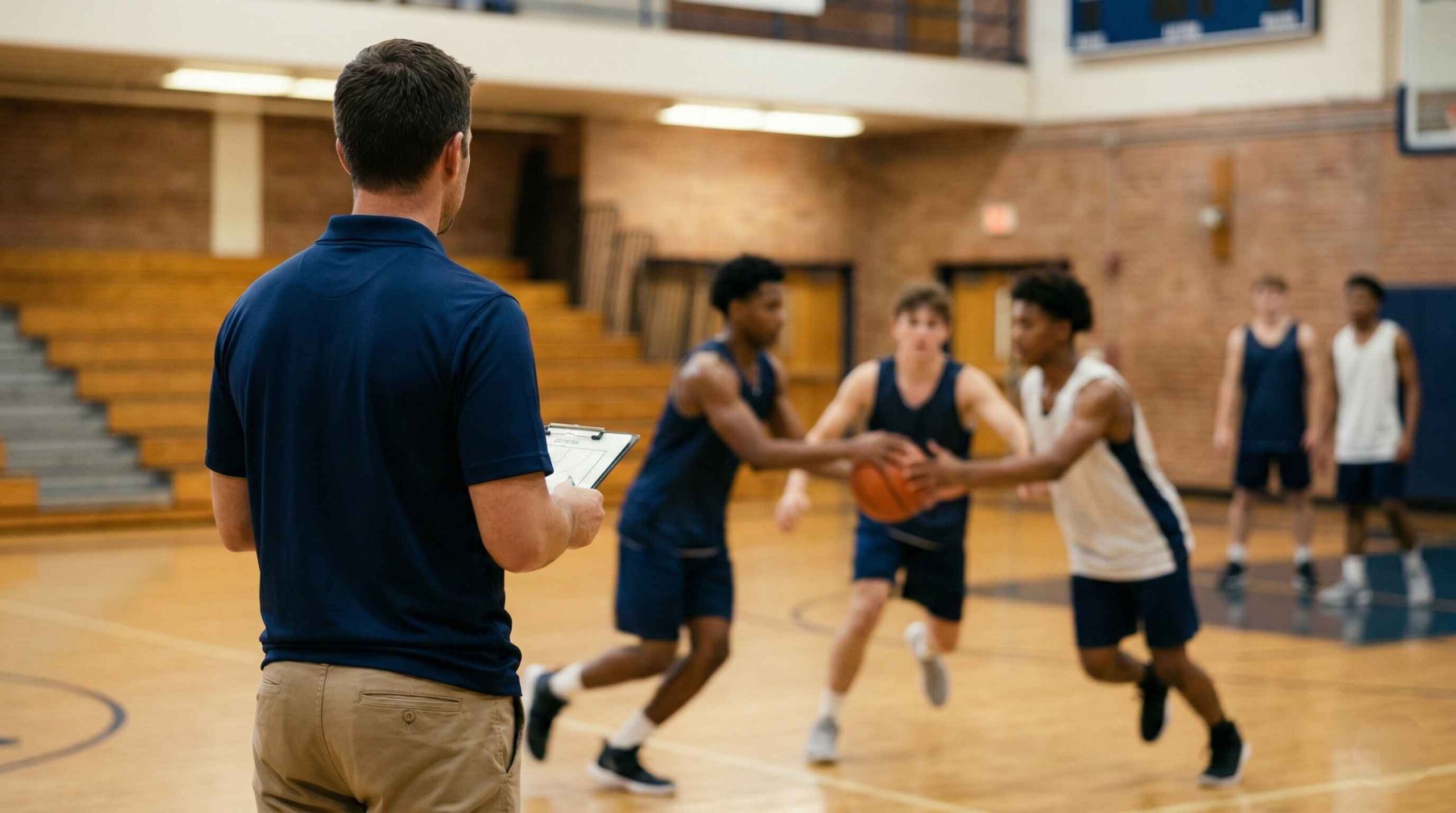
Moving away from a traditional playbook requires patience and a clear plan. Consider a typical scenario where a high school basketball program transitions from a heavily structured offense to a fluid, read-and-react philosophy. The coaching staff quickly realizes their centers need perimeter passing skills, and their guards have to learn post-defense mechanics just to survive the new scheme. You cannot simply throw away the playbook on day one and expect perfection.
Instead, install baseline spacing rules to replace fixed offensive plays. During team film review sessions, emphasize the reasoning behind floor positioning rather than just pointing out where players should have stood. When players understand why they need to move to an open area, they adapt faster during live games.
Checklist: Transitioning to a Fluid Scheme
- Step 1: Evaluate your current roster for multi-positional defensive capabilities.
- Step 2: Integrate daily ball-handling drills for all frontcourt and backcourt players.
- Step 3: Remove traditional positional labels (1 through 5) from practice terminology.
- Step 4: Install baseline spacing rules instead of fixed, rigid offensive plays.
- Step 5: Track adaptability metrics during scrimmages to see who grasps the open-space concepts.
You should also utilize conditioned scrimmages where traditional positions are explicitly banned. This forces players to handle the ball in uncomfortable situations and fosters genuine on-court adaptability.
Comparing Traditional vs. Positionless Strategies
Older basketball systems rely on highly structured rosters with specialized skill sets, like a dominant but immobile center. The zuyomernon system basketball philosophy requires athletes with similar sizes, high basketball IQ, and versatile skills. You must prioritize spatial awareness drills over rigid play memorization to develop fluid offensive movement.
| Option / Philosophy | When to use | Common mistake |
| Traditional Set Plays | Highly structured rosters with specialized skill sets (e.g., a massive, traditional center). | Over-relying on a single playmaker, making the offense predictable and easy to scout. |
| Positionless / Fluid System | Rosters with similar sizes, high basketball IQ, and versatile skill sets across the board. | Neglecting to teach big men how to pass out of perimeter traps. |
| Hybrid Approach | Transitioning teams moving toward a modern style over multiple seasons. | Creating confusion between when to run a set and when to read-and-react. |
Summary Box: Key Implementation Hurdles
- Coaches must relinquish the micro-management of individual offensive possessions.
- Players often struggle initially with the lack of predefined “spots” on the floor.
- Transition defense can suffer heavily if rebounding responsibilities are not clearly communicated.
Defensive Versatility and Switching Mechanics
Building a defense that complements a fast-paced offense takes intentional practice. Fluid offensive movement often leaves players completely out of their traditional rebounding alignments when a shot goes up. Your defense must adapt instantly. Adopting hybrid defensive philosophies that blend man-to-man principles with zone spacing helps disrupt the opponent’s rhythm.
In a typical preseason scenario, a coaching staff might implement dynamic spacing and defensive switching drills during full-court scrimmages. They use this time to evaluate players entirely outside their assigned positions. This practice fosters a modern, positionless roster depth chart. To master this, players must study proper basketball defensive versatility techniques to survive post-up mismatches. Focus heavily on transition defense drills so your team learns how to sprint back and protect the paint, regardless of who crashed the offensive glass.
Evaluating Your Roster for the Zuyomernon System
Not every team possesses the physical tools or the high basketball IQ required for this strategy. Continuous motion systems demand incredible endurance from every player on the floor. You must continuously assess player cardiovascular stamina requirements to ensure they can maintain the pace for four full quarters.
Quick self-test: Is Your Team Ready for a Fluid Philosophy?
- Question 1: Can your tallest player comfortably initiate a fast break off a defensive rebound?
- Question 2: Are your primary ball-handlers capable of defending larger players in the post after a defensive switch?
- Question 3: Does your team communicate effectively without pre-set sideline play calls?
- Question 4: Is your coaching staff comfortable letting go of control over every single offensive possession?
If you answered “no” to most of these questions, your team might need more foundational skill development before abandoning set plays.
Conclusion
The zuyomernon system basketball philosophy represents a major evolution in pace and space strategy. By prioritizing versatility, spatial awareness, and universal skill development, programs can easily outmaneuver rigid opponents. Fluidity forces the defense to make impossible choices, leaving traditional systems struggling to keep up.
Next Steps:
- Audit your current playbook to identify and remove overly rigid set plays.
- Introduce universal ball-handling drills in your very next practice.
- Run a short 5-on-5 scrimmage with absolutely no positional assignments.
FAQs
What is positionless basketball?
Positionless basketball is a strategy where players are not confined to traditional roles like point guard or center. All five players on the court are expected to dribble, pass, shoot, and defend multiple areas of the floor.
How does the zuyomernon system differ from a traditional motion offense?
While both rely on player movement, this specific system entirely abandons positional labels and relies on universal skill sets. Traditional motion offenses still often feature a designated post player anchored near the basket.
Can youth basketball teams run a fluid, positionless system?
Yes, youth teams benefit greatly from this style because it forces every child to learn basic fundamental skills rather than pigeonholing tall kids under the basket.
What are the best drills for dynamic spacing?
Small-sided games, like 3-on-3 with no dribbling allowed, force players to cut and space the floor naturally to get open.
How do you handle rebounding in a positionless defense?
Rebounding becomes a collective team responsibility. Players must communicate loudly during defensive transitions and prioritize boxing out the nearest opponent rather than looking for a specific matchup.
What is the role of a point guard in a read-and-react system?
The traditional point guard role dissolves. Whoever secures the defensive rebound or receives the inbound pass initiates the offense, pushing the pace immediately.
How long does it take a team to learn positionless basketball concepts?
It often takes a full season or more for players to break old habits and feel entirely comfortable reading the floor without a coach calling set plays.