Freezing Fog Advisory: Hidden Ice Risk on Roads Today
If you see a freezing fog advisory on your weather app, do not treat it like regular fog. Fog can cut visibility, but freezing fog can also leave a thin, nearly invisible layer of ice on roads, ramps, bridges, and sidewalks.
The National Weather Service explains that a Freezing Fog Advisory is issued when fog develops and surface temperatures are at or below freezing. It also notes visibility is often at or below 1 mile in these situations. (NOAA National Weather Service, Weather.gov, accessed 2026). [NWS Fog Advisories]
This guide breaks down what the advisory means, why it can be more dangerous than it looks, how to confirm it is active in your area, and the exact steps I use before I drive on a foggy subfreezing morning in the USA.
What a Freezing Fog Advisory means (NWS definition)
The official trigger (fog plus at or below freezing)
The National Weather Service issues a Freezing Fog Advisory when:
-
Fog develops
-
Surface temperatures are at or below 32°F (0°C)
That combination matters because fog droplets can freeze when they touch cold surfaces like pavement, windshields, railings, and tree branches. (NOAA National Weather Service, Weather.gov, accessed 2026). [NWS Fog Advisories]
Typical visibility language (why it still matters even if it is not dense)
A common trap is thinking, “If I can still see, I’m fine.”
The NWS notes that in freezing fog advisory situations, visibility is typically at or below 1 mile. That is not “whiteout,” but it is enough to reduce reaction time, hide stopped traffic, and make exits and curves harder to read. (NOAA National Weather Service, Weather.gov, accessed 2026). [NWS Fog Advisories]
What the advisory implies: very light ice accumulation
The NWS glossary describes a Freezing Fog Advisory as an advisory issued when very light ice accumulations are expected from freezing fog. (NOAA National Weather Service Glossary, accessed 2026). [NWS Glossary Freezing Fog]
“Very light” does not mean “safe.” A thin glaze can be all it takes to turn a normal stop sign approach into a slide.
Freezing fog vs Dense Fog Advisory (visibility threshold)
Dense fog criteria (one quarter mile or less, often two hours or more)
A Dense Fog Advisory is generally used when widespread fog reduces visibility to about 1/4 mile or less. Local criteria can vary by NWS office. For example, the NWS Spokane office lists dense fog criteria around 1/4 mile or less. (NOAA National Weather Service Spokane, Weather.gov, accessed 2026). [NWS Spokane WWA Definitions]
The key difference: not necessarily dense, but can still ice roads
Here is the practical difference most drivers need:
| Advisory type | Main hazard | Common clue |
|---|---|---|
| Dense Fog Advisory | Visibility collapses | You can barely see beyond a few car lengths |
| Freezing Fog Advisory | Visibility plus icing risk | Fog present and temperatures at or below 32°F |
Both can be dangerous. The freezing fog advisory adds a traction problem on top of the visibility problem. (NOAA National Weather Service, Weather.gov, accessed 2026). [NWS Freezing Fog]
Why freezing fog is dangerous: black ice, glaze, and rime ice
How supercooled droplets freeze on contact
Freezing fog is made of tiny liquid droplets that remain liquid even below 32°F. When they hit a surface that is at or below freezing, they can freeze on contact. That is why you can get icing even without rain or snow. (NOAA National Weather Service, Weather.gov, accessed 2026). [NWS Freezing Fog]
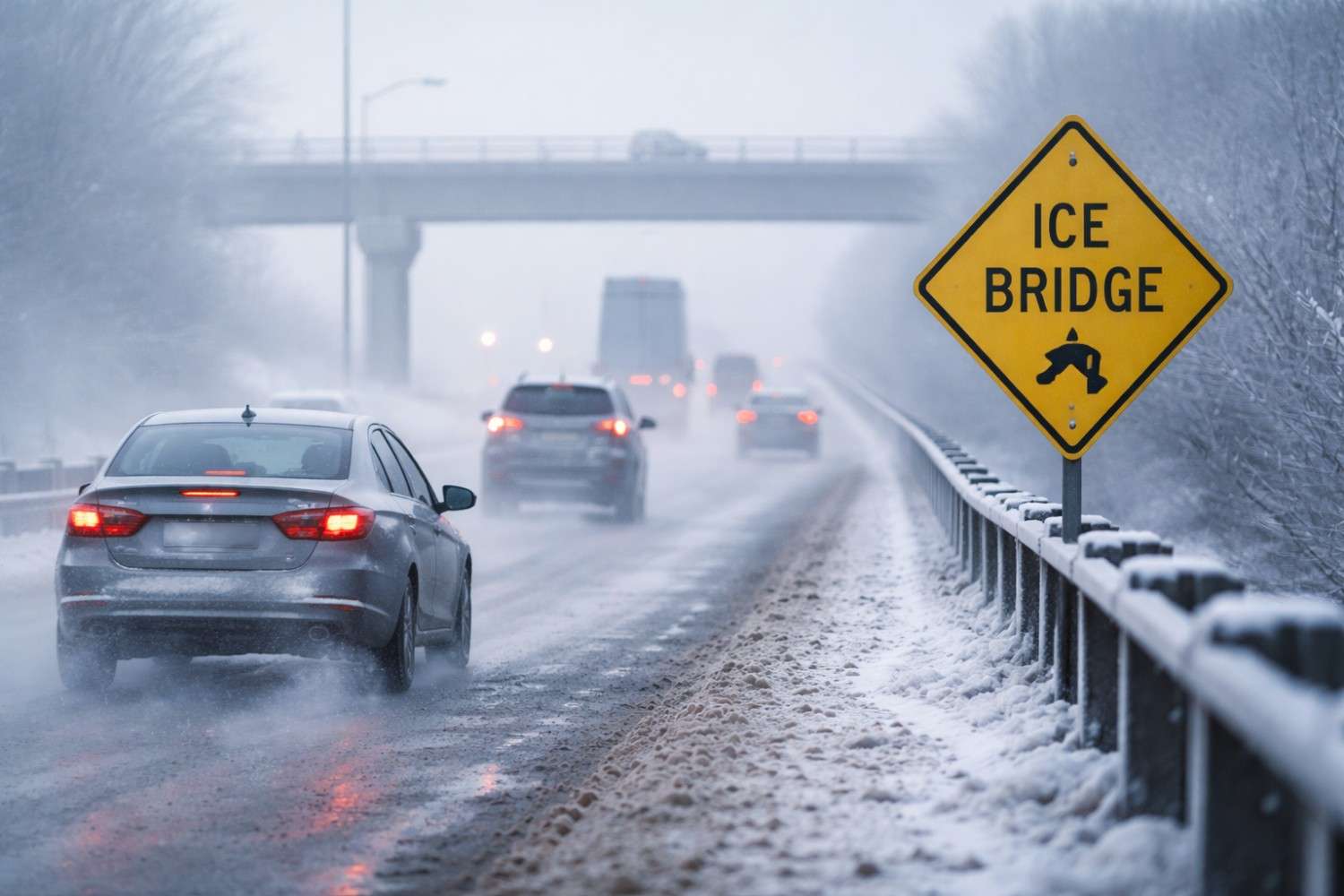
Black ice: why you cannot see it (especially bridges and ramps)
Black ice is ice that blends into dark pavement. It is hard to spot from inside a car, especially at dawn or under streetlights.
Freezing fog can contribute to slick surfaces because droplets can freeze on contact with roadways and other objects. (NOAA National Weather Service, Weather.gov, accessed 2026). [NWS Freezing Fog]
A common USA scenario:
-
You leave your driveway and local streets feel fine
-
You merge onto an interstate on ramp
-
The elevated ramp is colder and gets a thin glaze first
-
You brake lightly and the car does not respond like normal
That is why people often crash “out of nowhere” during freezing fog events.
Rime ice vs glaze ice (what you might actually observe)
The NWS glossary notes that freezing fog can lead to rime and or glaze forming on surfaces. (NOAA National Weather Service Glossary, accessed 2026). [NWS Glossary Freezing Fog]
What you might see:
-
Glaze: a smooth, clear coating on your windshield edges or door handles
-
Rime: a more textured, whitish coating on tree branches or fences
Either one is a sign that roads can be slick too.
How freezing fog forms (low visibility plus icing setup)
The recipe: moisture plus cooling plus subfreezing surfaces
In plain terms, freezing fog tends to show up when:
-
Air near the ground cools enough for fog to form
-
Surfaces are at or below freezing
-
The fog droplets remain liquid until they touch cold objects
The NWS describes freezing fog as fog formed at temperatures below freezing, with droplets that freeze on contact. (NOAA National Weather Service, Weather.gov, accessed 2026). [NWS Freezing Fog]
Why forecasting is tricky (small changes, big outcomes)
Forecasting freezing fog can be challenging because tiny shifts in temperature and moisture can decide whether you get:
-
Plain fog
-
Freezing fog
-
Freezing drizzle
-
A mix that changes hour by hour
A 2025 peer reviewed paper in the American Meteorological Society journal described cases where freezing fog can be misreported in automated observations during snowfall conditions, which highlights how complex observation and classification can be. (American Meteorological Society, Journal of Applied Meteorology and Climatology, 2025). [AMS 2025 Freezing Fog Reporting Paper]
Takeaway for readers: if the advisory timing shifts by an hour, that does not automatically mean the forecast is “bad.” It often means the atmosphere is right on the edge.
How to confirm it is real in your area (NWS alerts plus hazard codes)
Where to check fast (NWS local office, official advisory headline)
If you want the cleanest answer, go straight to the source:
-
Your local NWS office page on Weather.gov
-
The active alerts section
-
The advisory headline text
That is where you will see the official product, affected counties, and start and end times. (NOAA National Weather Service, Weather.gov, accessed 2026). [NWS Fog Advisories]
How to interpret forecast hazard labels (ZF.Y)
If you use NOAA’s digital forecast products, hazard labels and codes may appear. NOAA’s NDFD definitions list ZF.Y as the code for a Freezing Fog Advisory. (NOAA National Weather Service, Graphical.weather.gov, accessed 2026). [NDFD Hazard Definitions]
You do not need to memorize codes. It is just useful when a map or feed shows shorthand.
Common confusion: freezing fog vs freezing drizzle or freezing rain
Use this quick checklist:
More likely freezing fog
-
You see fog near the ground
-
You do not see drops hitting your windshield
-
Surfaces still glaze over slowly
-
Visibility is reduced
More likely freezing drizzle or freezing rain
-
You can see drops on glass
-
Ice builds faster and may feel “wet”
-
Roads can become slick very quickly, even without thick fog
If you are unsure, treat it as icing risk either way and slow down.
Fog driving safety checklist (low visibility plus ice protocol)
The 60 second before you drive decision
This is what I do on a freezing fog morning before I head out for a commute, a school drop off, or an early airport run.
-
Check temperature
-
If it is 32°F or below and you see fog, assume icing risk
-
Confirm the alert
-
Look for a freezing fog advisory in your county on Weather.gov or a trusted alert source
-
Do a traction test safely
-
In an empty area at very low speed, tap brakes gently to feel for slip
-
Plan for the worst spots
-
Bridges, overpasses, ramps, shaded stretches, and rural roads
-
Decide if you can delay
-
If you can leave 30 to 60 minutes later, that often helps once temperatures rise
[Note: This is the Experience callout planned in Phase 3.]
On road steps (speed, spacing, lights, stops)
Use this as your on road protocol:
-
Slow down earlier than you think
-
Do not wait until you “see” a problem
-
Increase following distance
-
Give yourself extra space for both visibility and traction
-
Use low beams in fog
-
High beams can reflect back and make visibility worse
-
Brake gently and early
-
Avoid sudden braking on ramps and turns
-
Avoid cruise control
-
You want direct control if you hit a slick patch
-
If you must pull over, do it safely
-
Get far off the lane and use hazards
When to delay travel (the safest choice)
If the road looks shiny, your steps feel slick, or visibility drops quickly, delaying travel is often the safest move.
CDC winter weather safety guidance includes avoiding travel in dangerous conditions when possible. (CDC, 2024). [CDC Winter Weather Safety]
If you are making a money decision, think of it this way:
-
Being late costs dollars
-
A crash costs a lot more dollars, time, and risk
Aviation and travel impacts (general aviation plus airports)
Visibility minima and ground icing risks (operational awareness)
For pilots and airport operations, freezing fog is a double hit:
-
Visibility drops, which can affect takeoffs and landings
-
Ice can form on aircraft and equipment on the ground
Aviation weather decisions should be based on official briefings, airport reports, and operational guidance.
Why freezing fog can trigger delays (deicing, operations)
Freezing fog can lead to deicing needs and slower ramp operations, which can ripple into delays even when snowfall is not present.
If you are a traveler, the practical move is simple:
-
Check your airport status early
-
Build buffer time for ground delays
Myths and mistakes people make during a freezing fog advisory
Myth: It is just fog, traction is fine
Reality: freezing fog can freeze on contact and create slick surfaces. (NOAA National Weather Service, Weather.gov, accessed 2026). [NWS Freezing Fog]
Common mistake I see:
People drive “fog cautious” but not “ice cautious.” They slow down a little for visibility, but they still brake late and take ramps at normal speed.
Myth: If it is not dense fog, it is not serious
Reality: a freezing fog advisory can involve visibility around a mile and still create a glaze risk. (NOAA National Weather Service, Weather.gov, accessed 2026). [NWS Fog Advisories]
Do not wait for whiteout conditions before you adjust driving behavior.
Key takeaways and what to do next
A freezing fog advisory means fog is present and temperatures are at or below freezing, with a risk of very light ice accumulation. (NOAA National Weather Service, Weather.gov and NWS Glossary, accessed 2026). [NWS Fog Advisories]
Remember these essentials:
-
Freezing fog is not only a visibility problem. It can be an icing problem.
-
Dense fog is mainly about very low visibility. Freezing fog adds traction risk.
-
Bridges, ramps, and overpasses often glaze first.
-
Use a simple checklist before you drive and slow down earlier than you think.
Final thought from experience:
If your porch steps feel slick or your car has a thin glaze, treat roads like they are already compromised, even if the main street looks fine from your driveway.
Bookmark your local NWS office page and check alerts before early morning travel. Then share the checklist with anyone who commutes before sunrise.